


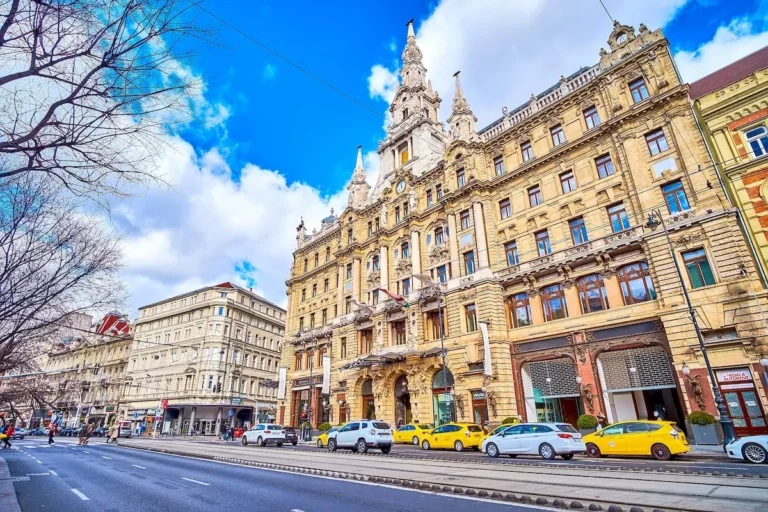
Budapest’s hotel market closed 2025 with a symbolic breakthrough: the number of guest nights in the Hungarian capital’s hotels exceeded pre-pandemic levels, according to CBRE’s latest market report.
Accommodation providers booked 9.9 million guest nights last year, 4% above 2019 and 6.5% higher than in 2024. International visitors were the main engine, accounting for 8.5 million guest nights, up 7% year-on-year.
In terms of guest nights, Budapest now ranks 19th among major European cities, yet stands out as the fastest-growing among the larger markets, with forecasts pointing to an 11.7% compound annual growth rate between 2024 and 2030, far ahead of runners-up such as Florence.

Development reshapes the capital
In 2025, ten new hotels opened in Budapest, adding 819 rooms to the market and setting the stage for a powerful development cycle. Another roughly 15 hotel projects are already under construction, representing close to 2,300 rooms scheduled to come online between 2026 and 2029, of which some 1,800 rooms could open as early as this year.
On top of that, an additional 2,000 rooms are in the planning pipeline, many of them linked to office-to-hotel conversion projects that recycle obsolete office stock into higher-yielding hospitality assets.
The expansion is attracting international brands that have so far been absent from the Budapest map. Market players expect several newcomers to debut in the capital over the next few years.
Airbnb clampdown supports hotels and aparthotels
From January 2026, a district-level ban on so-called Airbnb services took effect in Budapest’s District VI, one of the city’s densest short-term rental hotspots. As private listings retreat, hotels and professionally run aparthotels are stepping into the gap.
The impact was immediate: according to the Hungarian Central Statistical Office, the number of private and alternative accommodation units in the district shrank from more than 1,800 with nearly 2,500 rooms in January 2025 to just 574 units and 927 rooms a year later.

The aparthotel niche looks set to be one of the main beneficiaries of this regulatory pivot. Positioned between classic hotels and short-term rentals, these properties combine apartment-style units equipped with kitchens with fully digital check-in and room access via smartphone.