

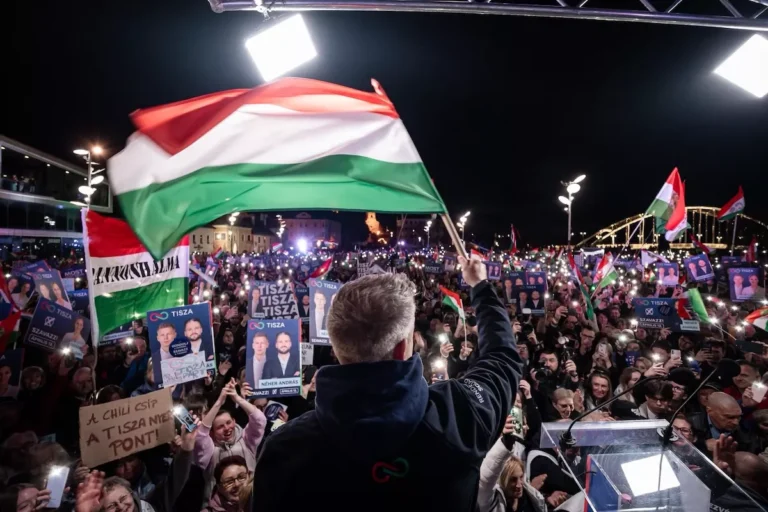
Hungary’s long-dominant Fidesz party, led by Prime Minister Viktor Orbán, conceded defeat late Sunday after election results showed opposition leader Péter Magyar’s Tisza Party poised for 138 of 199 parliamentary seats with over 98% of votes tallied.
The result ends 16 years of Fidesz rule, marred by economic stagnation, corruption scandals, and international isolation that voters appeared ready to reject. Turnout hit a record 79% amid widespread frustration over Hungary’s post-pandemic woes.
Final seat picture
The final parliamentary balance gives Tisza a governing majority and possibly the ability to shape constitutional changes, depending on the exact seat distribution. Fidesz’s reduced representation leaves Orbán with a far weaker position than at any point since he returned to power in 2010.

Mi Hazánk’s entry into parliament adds a further layer of political fragmentation, but it does not change the central fact of the election: the opposition has won decisively, and Orbán’s era at the top of Hungarian politics is over.
Global leaders hail democratic turn
Foreign leaders moved quickly to welcome the outcome. Reuters reported that German Chancellor Merz congratulated Magyar, while French President Macron also reached out after the result became clear.
European Parliament President Roberta Metsola also congratulated Magyar, calling Hungary “at the heart of Europe,” while other European leaders framed the result as a return to democratic competition and a possible reset in Hungary’s relations with Brussels.
Orbán’s political collapse
The final result reflects not just a campaign defeat, but the collapse of a governing model that once looked durable. Orbán’s system depended on economic patronage, media dominance, loyal institutions and a rural base that repeatedly delivered him supermajorities, yet none of those advantages held once voters turned against him in large numbers.
Hungary’s record turnout suggests that the election became a direct referendum on Orbán himself. Tisza’s broad appeal among urban voters, moderates and disillusioned conservatives proved enough to break Fidesz’s long hold on power.

Orbán’s biggest weakness was the economy. Inflation, weak purchasing power and frustration over living standards steadily eroded confidence in a government that had promised stability and national strength.