

When Formula 1 arrived on the outskirts of Budapest in August 1986, the event was about far more than motorsport. Held in communist Hungary, it became the first Formula 1 Grand Prix staged behind the Iron Curtain, marking a rare moment when one of the world’s premier sporting competitions crossed the political divide of Cold War Europe.
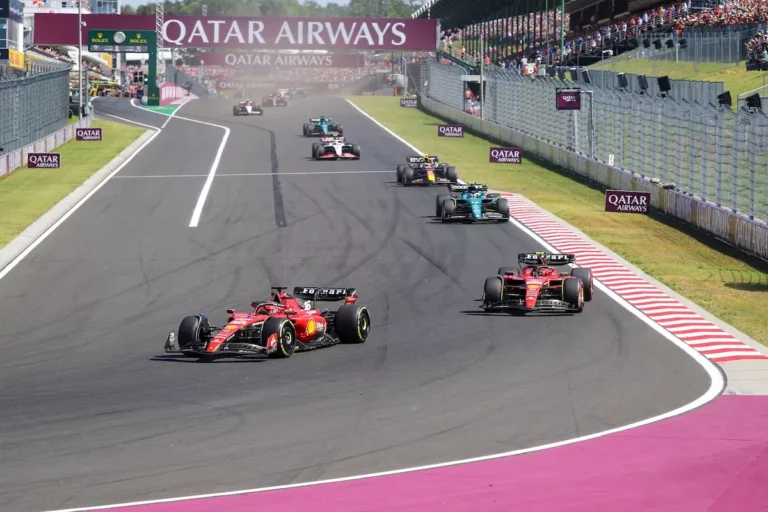
Four decades later, the Hungaroring has become one of Formula 1’s most established venues and one of Hungary’s strongest international sporting brands. The 2026 Hungarian Grand Prix, which celebrated the circuit’s 40th anniversary, had around 300,000 spectators over a race weekend, roughly 80% of them from abroad.
A circuit born from geopolitical ambition
Formula 1’s expansion into Eastern Europe began in the mid-1980s. Initially, organisers considered reviving Budapest’s historic Népliget street circuit. Hungarian authorities instead opted to build a purpose-designed permanent facility in nearby Mogyoród, approximately 20 kilometres northeast of the capital.
Construction began in 1985 and was completed in just eight months, an extraordinary timeframe for a Formula 1 grade circuit that remains remarkable even by today’s standards.
When the inaugural Hungarian Grand Prix took place on 10 August 1986, the Hungaroring entered history as Formula 1’s first venue behind the Iron Curtain. The race attracted an estimated 200,000 spectators, many travelling from neighbouring socialist countries where Formula 1 had never before been accessible.
Building a national brand
Unlike many Formula 1 circuits named after nearby cities or regions, Hungary deliberately chose a name that would represent the entire country. The name combines “Hungaro”, referencing Hungary, with “Ring”, the German term widely used for permanent racing circuits, as seen at Nürburgring and Hockenheimring.
The branding proved remarkably successful. Today, the Hungaroring is recognised globally without requiring geographical explanation, becoming one of Hungary’s most internationally recognised sporting assets.
More than just a race track
Although famous for its technical demands, the Hungaroring has become equally important as an economic driver. Each Formula 1 weekend transforms Budapest into one of Europe’s busiest tourism destinations.
Around 300,000 spectators attend the event across the three-day weekend, with international visitors accounting for roughly four out of every five attendees. Hotels across Budapest and the surrounding region typically operate near full capacity, while airlines, restaurants, taxis, ride-hailing platforms and businesses benefit from one of the country’s busiest weekends.
The global television audience further amplifies Hungary’s visibility, broadcasting images of Budapest and the surrounding region to viewers in more than 200 countries and territories.
Constant investment keeps the Hungaroring competitive
Remaining on the Formula 1 calendar requires continuous investment. As Formula 1 modernises its standards for teams, media and hospitality, Hungary has embarked on the largest redevelopment project in the Hungaroring’s history.
The ongoing modernisation includes a completely new paddock building, a rebuilt main grandstand with more than 10,000 seats, expanded hospitality facilities, new pedestrian tunnels improving visitor access, upgraded digital infrastructure, including 5G connectivity, thousands of new lighting installations and hundreds of kilometres of electrical cabling.
The redevelopment aims to secure the circuit’s long-term future as Formula 1 becomes increasingly competitive in selecting host venues, with countries in the Middle East, Asia and North America investing billions to attract Grands Prix.

A circuit where precision outweighs power
Measuring 4.381 kilometres, the Hungaroring consists of 14 corners completed over a 70-lap race distance of 306.63 kilometres. Drivers frequently describe it as “Monaco without the walls.”
Its narrow layout, technical corners and limited overtaking opportunities place exceptional importance on qualifying performance, tyre management and race strategy rather than outright speed.
Originally measuring just over four kilometres, modifications in 1989 and a significant redesign in 2003 extended the layout and improved overtaking opportunities, particularly around Turn One, while preserving its technical character.
Four decades of unforgettable Formula 1 moments
Over forty years, the Hungaroring has produced some of Formula 1’s most memorable races. The inaugural event in 1986 featured Nelson Piquet’s spectacular overtaking manoeuvre around the outside of Ayrton Senna, still regarded as one of Formula 1’s greatest passes.
In 1997, Damon Hill came within a single lap of delivering an unlikely victory for Arrows before a mechanical failure allowed Jacques Villeneuve to claim the win. Fernando Alonso secured his maiden Formula 1 victory in Budapest in 2003, becoming the youngest Grand Prix winner at the time.
Three years later, Jenson Button celebrated his first Formula 1 victory during a rain-affected Hungarian Grand Prix that remains one of the championship’s classic races. More recently, Esteban Ocon claimed a surprise maiden victory in 2021 after one of Formula 1’s most chaotic opening laps.
No driver has mastered the Hungaroring quite like Lewis Hamilton. The seven-time world champion has won the Hungarian Grand Prix a record eight times and claimed nine pole positions at the circuit, achievements recognised this year with one of the Hungaroring’s corners officially named in his honour as part of the 40th anniversary celebrations.
The 40th Hungarian Grand Prix delivers another strategic classic
McLaren’s Lando Norris claimed victory after a race dominated by tyre strategy, reliability and tactical execution rather than outright pace. He finished ahead of Max Verstappen, while championship leader Kimi Antonelli completed the podium to maintain his advantage in the drivers’ standings heading into Formula 1’s summer break.