

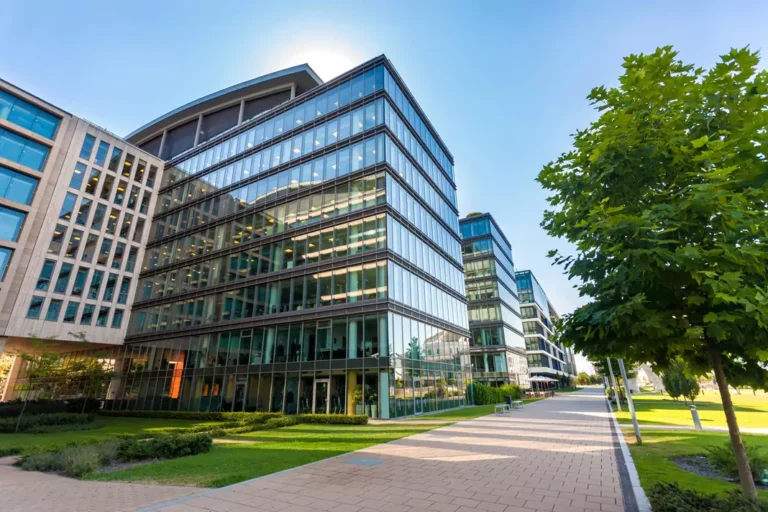
After a subdued 2024, Hungary’s real estate investment market roared back to life in 2025. Total volumes climbed to EUR 881 million, a remarkable 117.5% increase from the record-low previous year, according to Colliers.
The office sector dominated transactions, representing over 50% of total investment activity. Notable deals included the IP West office building and the Science Park business center, underscoring Budapest’s enduring position as the hub of corporate real estate.
Vacancy rates improved across the Capital, with net absorption nearing 100,000 sqm and speculative deliverables totaling just over 80,000 sqm during 2024–2025. The Liberty North Wing, spanning 19,779 sqm, led handovers for the period. By the end of 2025, overall office vacancy stabilized at 15.9%, particularly tight in Central and North Buda.

The speculative office pipeline through 2028 totals only 138,900 sqm, with under 50,000 sqm expected by the end of 2026. The Váci Corridor will command most of this development, hosting major upcoming projects like Centerpoint III, H2O Offices Phase II, and Láng Negyed V1.
Industrial market builds strong momentum
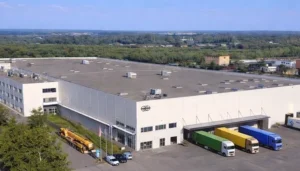
Hungary’s industrial real estate also posted a robust year, with 476,000 sqm of completions in 2025. About 69% of this space was delivered around Budapest, while 31% emerged in regional cities. The vacancy rate stood at 37%, supported by rising demand.
Net take-up in Greater Budapest reached 447,820 sqm, roughly 80,000 sqm more than in 2024. Pre-leases dominated market activity, and the final quarter of the year closed on a strong note, accounting for 45% of total take-up.
Large-scale industrial deals, exceeding 10,000 sqm, are becoming the norm rather than the exception, a trend that has accelerated since the pandemic. The development pipeline now totals 551,458 sqm, with 43% already pre-leased. Notably, Budapest’s share stands at 300,681 sqm (53% pre-leased), while the countryside is at 250,777 sqm (60% pre-leased).
Investment and construction are gradually expanding into eastern hubs, including Debrecen, Miskolc, Nyíregyháza, and Kecskemét, signaling a broader geographic diversification of Hungary’s industrial landscape.

Retail market moves to a renovation-first approach
On the retail front, new developments have largely been sidelined in favor of modernizing existing shopping centers. The most notable exception is the redevelopment of the Duna Mall in Budapest, which is being rebuilt as a larger, more upscale destination, slated for completion in 2029.