

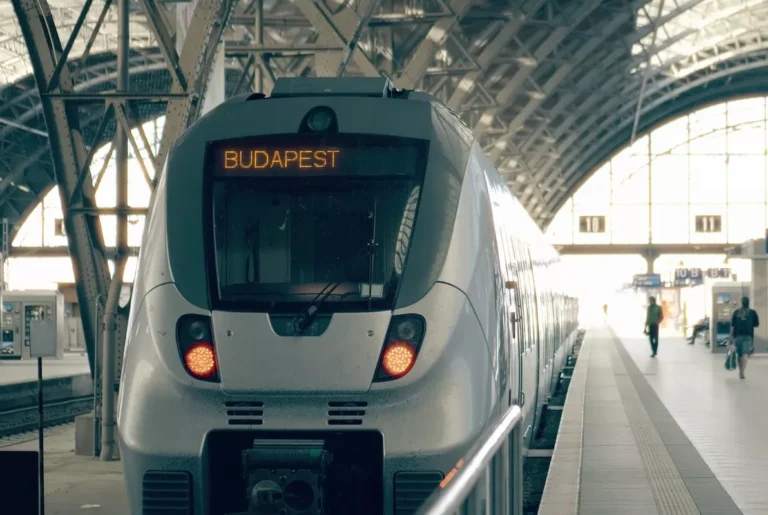
Hungary has unveiled the Baross Gábor Railway Development Plan, a decade-long investment program worth approximately HUF 3.55 trillion, aimed at transforming the country’s railway infrastructure. The majority of financing will come from European Union funds.
The investment package includes HUF 1,800 billion from recovered EU funds available during the current programming period, HUF 950 billion earmarked for projects between 2028 and 2034, a HUF 400 billion loan from the European Investment Bank and an additional HUF 400 billion through concession-type financing.
New rolling stock
A key pillar of the Baross Gábor Railway Development Plan is the renewal of Hungary’s passenger fleet. The government plans to procure 35 high-capacity InterCity multiple units for the country’s principal long-distance routes and 42 new HÉV suburban trains serving the Szentendre, Csepel and Ráckeve lines in the Budapest metropolitan area.
The new InterCity fleet will gradually replace aging rolling stock on routes linking Budapest with Győr, Sopron, Szombathely, Veszprém, Zalaegerszeg, Pécs, Kecskemét and Szeged, while circular InterCity services connecting Miskolc, Nyíregyháza, Debrecen and Szolnok will also benefit from the investment.
Budapest rail network to undergo major modernization
The capital and its commuter network account for one of the largest components of the investment program. The government plans to reconstruct and modernize the Szentendre, Csepel and Ráckeve HÉV lines, including infrastructure upgrades, improved accessibility and the introduction of new rolling stock.
Major redevelopment projects are also planned for Nyugati Railway Station, while the Southern Railway Ring will be reconstructed together with three new railway stations designed to increase capacity around Budapest.
Another flagship project is the complete redevelopment of Rákosrendező, which the government envisions as the centre of a new urban district supported by expanded tram infrastructure, including a new bridge crossing the railway corridor.
The modernization program also includes upgrades to the Veresegyház and Lajosmizse suburban railway lines through partial double-tracking, while the Lajosmizse line will also be electrified. Additional tram projects in both Buda and Pest are included in the long-term transport strategy.
Regional corridors receive long-term investment
Beyond the capital, the Baross Gábor Railway Development Plan extends to every major region of Hungary. In western Hungary, the Budapest-Győr-Sopron and Budapest-Szombathely corridors will receive significant upgrades, while Győr railway station will be modernized.
The construction of the Zalaszentiván delta connection will establish a direct rail link between Szombathely and Zalaegerszeg, while electrification and reconstruction of the railway toward Nagykanizsa will strengthen both passenger and freight transport.
One of the largest projects in northern Hungary will be the complete reconstruction of the most deteriorated section of the Budapest-Miskolc railway corridor. The upgrade will allow trains to operate at speeds of up to 160 km/h, reduce delays, modernize stations and shorten journey times toward Miskolc, Eger and Gyöngyös.
Further east, Debrecen will see the reconstruction and accessibility upgrade of its main railway station, alongside improvements to suburban rail services. Electrification toward Balmazújváros is nearing completion, while authorities are also examining future tram-train connections serving the wider metropolitan area.
In southern Hungary, the comprehensive modernization of the Budapest-Szeged main line is expected to shorten InterCity journey times by around 15 minutes, improve freight capacity and increase maximum operating speeds to 160 km/h.

In central and southern Transdanubia, the Székesfehérvár-Lepsény railway will be rebuilt as a fully double-track 160 km/h corridor, improving access to both shores of Lake Balaton. Several stations around the lake will also be renovated and made fully accessible.
Improvements around Székesfehérvár station aim to strengthen integration with regional bus services. On the Budapest-Pécs corridor, the government plans to establish hourly InterCity services linking the capital with Baranya County.