

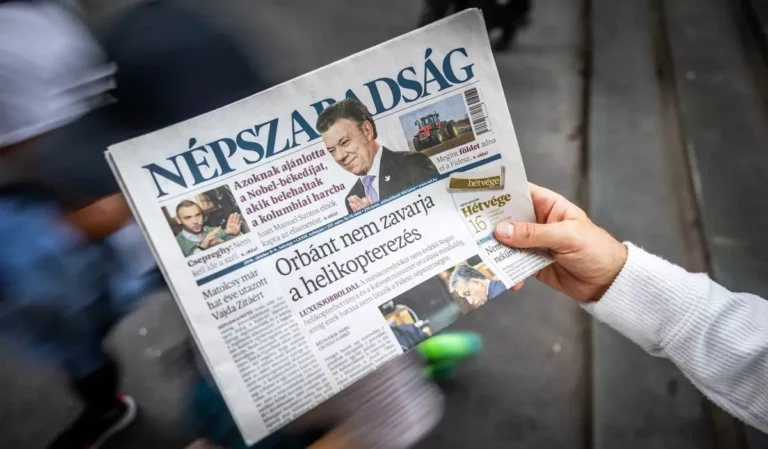
Exactly a decade after its sudden closure became one of the defining moments in Hungary’s media history, Népszabadság has returned. Once the country’s leading political daily, the newspaper relaunched online on October 8, 2026, backed by new investors, a newsroom of around 90 journalists and funding intended to cover its first two years of operation.
The revived publication is available at nszo.hu, with a weekly print edition expected to reach readers on October 15. The relaunch comes amid a transformation of Hungary’s media landscape following Viktor Orbán’s defeat in the April 2026 parliamentary election.
October 8, 2016: the day a newspaper disappeared
On the morning of October 8, 2016, Népszabadság journalists were preparing to move to new offices when publisher Mediaworks unexpectedly suspended publication. The newspaper’s website went offline, journalists lost access to editorial systems, and the company announced that operations had been halted.

Mediaworks justified the decision on financial grounds. According to the publisher, Népszabadság had lost more than 100,000 daily readers over the previous decade and accumulated losses exceeding HUF 5 billion, equivalent to approximately €16.7 million at the time.
Journalists disputed the explanation, arguing that the closure was politically motivated and linked to the paper’s criticism of the Orbán government. The timing intensified those suspicions. Earlier that year, the paper had published investigations involving government figures, including a controversy over helicopter travel by senior politician Antal Rogán.
Later in October 2016, Mediaworks was acquired by Opimus Press, a company associated with business interests close to Lőrinc Mészáros, an ally of Orbán. Mészáros denied involvement in the acquisition at the time.
From the Communist era to a leading independent political daily
Népszabadság’s history stretches back to November 2, 1956, when its first issue appeared during the Hungarian uprising against Soviet domination. Its name translates roughly as People’s Freedom, although the newspaper’s history reflects the contradictions of Hungary’s political development.
For decades, it served as the official newspaper of the Hungarian Socialist Workers’ Party during Communist rule. After the political transition of 1989, it evolved into a commercially operated, left-leaning newspaper with a reputation for political reporting, commentary and investigative journalism.

At its peak, Népszabadság was one of Hungary’s most widely circulated newspapers. Its audited daily circulation reached approximately 460,000 copies in 1989 before declining sharply as the internet reshaped the media industry. By the second quarter of 2016, circulation had fallen to approximately 37,000 copies.
A new owner, 90 journalists and two years of funding
The revived Népszabadság is published by Liberty Press, which also holds the publishing rights to the Hungarian publications Népszava and Jelen. 90% of Liberty Press will be controlled by 4Sight Media Group, a newly established company backed by four Hungarian private investors through their corporate interests.
The remaining 10% will belong to Ákos Tóth, the newspaper’s editor-in-chief and a former deputy editor at the original Népszabadság. The investors have committed sufficient initial financing to support approximately two years of operations.
The business model is expected to rely on subscriptions and advertising revenue, with the longer-term ambition of reaching financial sustainability. For Tóth, the editorial mission is centred on rebuilding traditional reporting rather than simply reviving a political brand.
A 64-page weekly newspaper in a digital-first business
The new Népszabadság has adopted a substantially different publishing strategy from the daily newspaper that closed in 2016. Its digital edition will cover Hungarian and international affairs, politics, business, society and culture, combining breaking news with analysis, interviews and in-depth reporting.

The print product will be published weekly rather than daily, initially with 64 pages. Content from Népszava will also appear in the new weekly edition, while the group’s existing digital properties are being reorganised.