

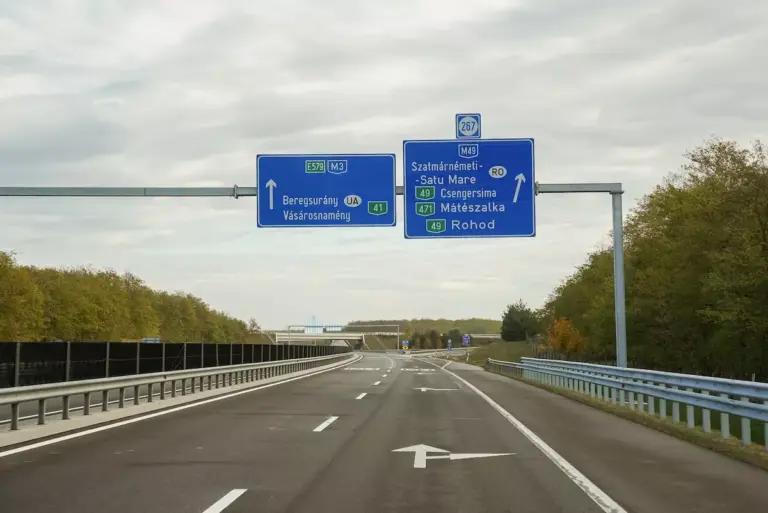
Hungary has opened the first 28.2-kilometre section of the M49 expressway, a HUF 138 billion (€350 million approximately) infrastructure investment designed to improve road connections between the M3 motorway and the Romanian border.
The government plans to complete the remaining 17.5 kilometres by 2029, potentially creating a new high-speed transport link between eastern Hungary and northwestern Romania.
The new section, connecting the M3 motorway with Ököritófülpös in Szabolcs-Szatmár-Bereg county, opened to traffic at 2 p.m. on October 27, according to Transport and Investment Minister Dávid Vitézy.

The dual-carriageway expressway has two lanes in each direction and a design speed of 110 kilometres per hour. It is expected to divert transit traffic from Route 49, which currently carries vehicles travelling towards the Romanian border.
A HUF 279 billion investment across two construction phases
The completed first phase cost HUF 138 billion and was financed from Hungary’s central government budget. Construction included four grade-separated interchanges, five roundabout junctions, 22 engineering structures and a separate 3.3-kilometre bypass near Győrtelek.
According to Hungarian news agency MTI, the second phase between Ököritófülpös and the border near Csenger is already under construction, with a contracted value of HUF 141 billion.
Together, the two Hungarian phases represent approximately HUF 279 billion in contracted and completed investment, covering around 45.7 kilometres of expressway. The second phase is scheduled for completion in 2029, when the M49 is expected to connect with a planned Romanian high-speed road towards Satu Mare.
Transit traffic through Mátészalka could fall by 70%
The Hungarian government estimates that the new expressway could reduce transit traffic through Mátészalka and neighbouring settlements by approximately 70%. Motorists and commercial vehicles can use the newly opened section free of charge until December 31, 2026.

From January 2027, passenger vehicles will require the appropriate motorway vignette, while heavy goods vehicles will become subject to distance-based road tolls.