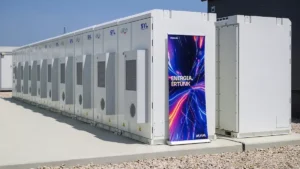


MOL has completed a HUF 21.6 billion solar and battery storage investment at its Algyő oil and gas production base, combining a 37.4 MWp solar park with a 40 MWh battery system.
The new solar facility, together with power generation already operating at the site, can cover the full electricity requirement of MOL’s Algyő operations. The project is expected to reduce carbon dioxide emissions by around 13,000 tonnes annually.
The development also takes MOL’s Hungarian solar portfolio to nine parks with a combined capacity of 405 MW, while the company now operates two battery storage facilities with a total capacity of 80 MWh.
Construction of the solar park took around 18 months
The solar component required an investment of HUF 17.6 billion, including HUF 5.566 billion in non-refundable support from Hungary’s Ministry of Foreign Affairs and Trade. The battery storage system cost another HUF 3.975 billion, of which HUF 1.628 billion was financed through EU Recovery and Resilience Facility funding.
The solar park covers more than 40 hectares. ALTEO was responsible for its construction, while EXTOR Elektronikai built the battery facility, consisting of eight battery containers, four transformer units and a control building.
Output equivalent to 22,500 households
Annual production from the solar park is equivalent to the electricity consumption of around 22,500 average households in Csongrád-Csanád county, according to MOL public data.
The battery has a rated output of 20 MW and storage capacity of 40 MWh. Over a year, the amount of electricity it can store and discharge is equivalent to the annual consumption of roughly 7,300 average households in the county.
The storage unit may also participate in system-balancing services operated by Hungarian transmission system operator MAVIR. It can discharge when MOL needs to reduce electricity drawn from the public grid and charge when excess power is available.

MOL targets 500 MWh of storage by 2030
Algyő is MOL’s second 40 MWh battery project in Hungary after the company commissioned a similar facility at its Tiszaújváros petrochemical site in March. Together, the two projects provide 80 MWh of storage capacity, while MOL plans to increase its Hungarian electricity storage portfolio to 500 MWh by 2030.