

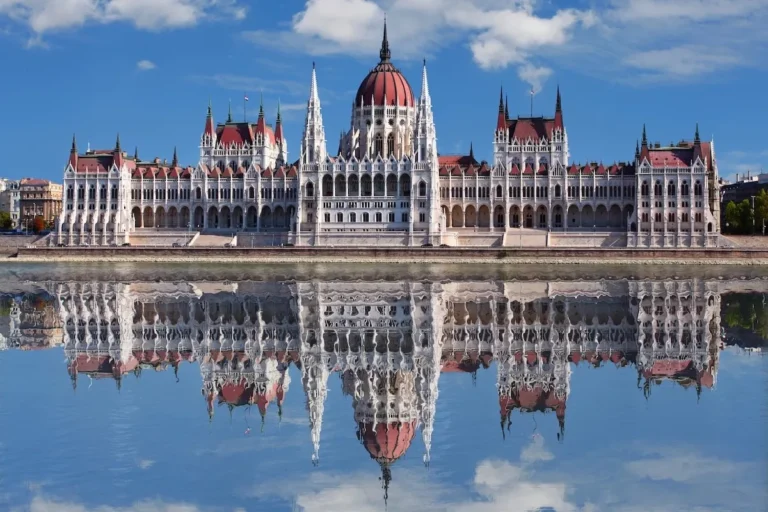
Few buildings capture the spirit of a nation quite like the Hungarian Parliament. Rising majestically on the banks of the Danube, its soaring Neo-Gothic silhouette has long defined Budapest’s skyline.
Now, it has earned another prestigious distinction after being named Europe’s most beautiful building by British travel magazine LoveExploring, surpassing some of the continent’s most celebrated architectural landmarks.
The publication compared standout buildings from 40 European countries, selecting one iconic structure from each before producing an overall ranking. Hungary’s Parliament secured the top position, finishing ahead of Austria’s Belvedere Palace, Switzerland’s Chillon Castle, France’s Mont-Saint-Michel Abbey and even Rome’s world-famous Trevi Fountain.

A masterpiece more than two decades in the making
The Hungarian Parliament construction began in 1885 following a design competition won by renowned Hungarian architect Imre Steindl. Inspired by London’s Palace of Westminster, Steindl created a distinctly Hungarian interpretation of Neo-Gothic architecture, blending Gothic Revival elements with Renaissance influences.
The Parliament was officially inaugurated in 1902, although construction and decorative work continued until 1904, when the monumental project was finally completed. Today, more than 120 years later, it remains the seat of Hungary’s National Assembly and one of the country’s defining landmarks.
One of the world’s largest parliament buildings
Beyond its striking appearance, the Hungarian Parliament impresses through its sheer scale. Stretching 268 metres in length and 123 metres in width, it is the largest building in Hungary and ranks among the world’s largest legislative buildings.
Its iconic central dome rises 96 metres above the city, a symbolic reference to 896 AD, the year traditionally associated with the Hungarian conquest of the Carpathian Basin. Also, the number 96 appears repeatedly throughout the building’s design.
Inside, the Parliament is equally remarkable. It contains 691 rooms, 29 staircases, 10 internal courtyards and nearly 20 kilometres of corridors, making it one of Europe’s most complex public buildings.

Its construction required more than 40 million bricks, approximately 500,000 decorative stones and around 40 kilograms of 23-carat gold, much of which still adorns the lavish interior.
More than a government building
Although Parliament remains Hungary’s legislative centre, it has also become one of the country’s most visited cultural attractions. Since 2000, the building has housed the Holy Crown of Hungary, together with the coronation regalia, making it not only the political heart of the nation but also one of its most significant historical sites.
The Parliament also forms part of the UNESCO World Heritage Site that encompasses the Banks of the Danube, recognised for its outstanding architectural and cultural value.